




All-on-4 Implant
A Fixed Solution for Full Arch Tooth Loss
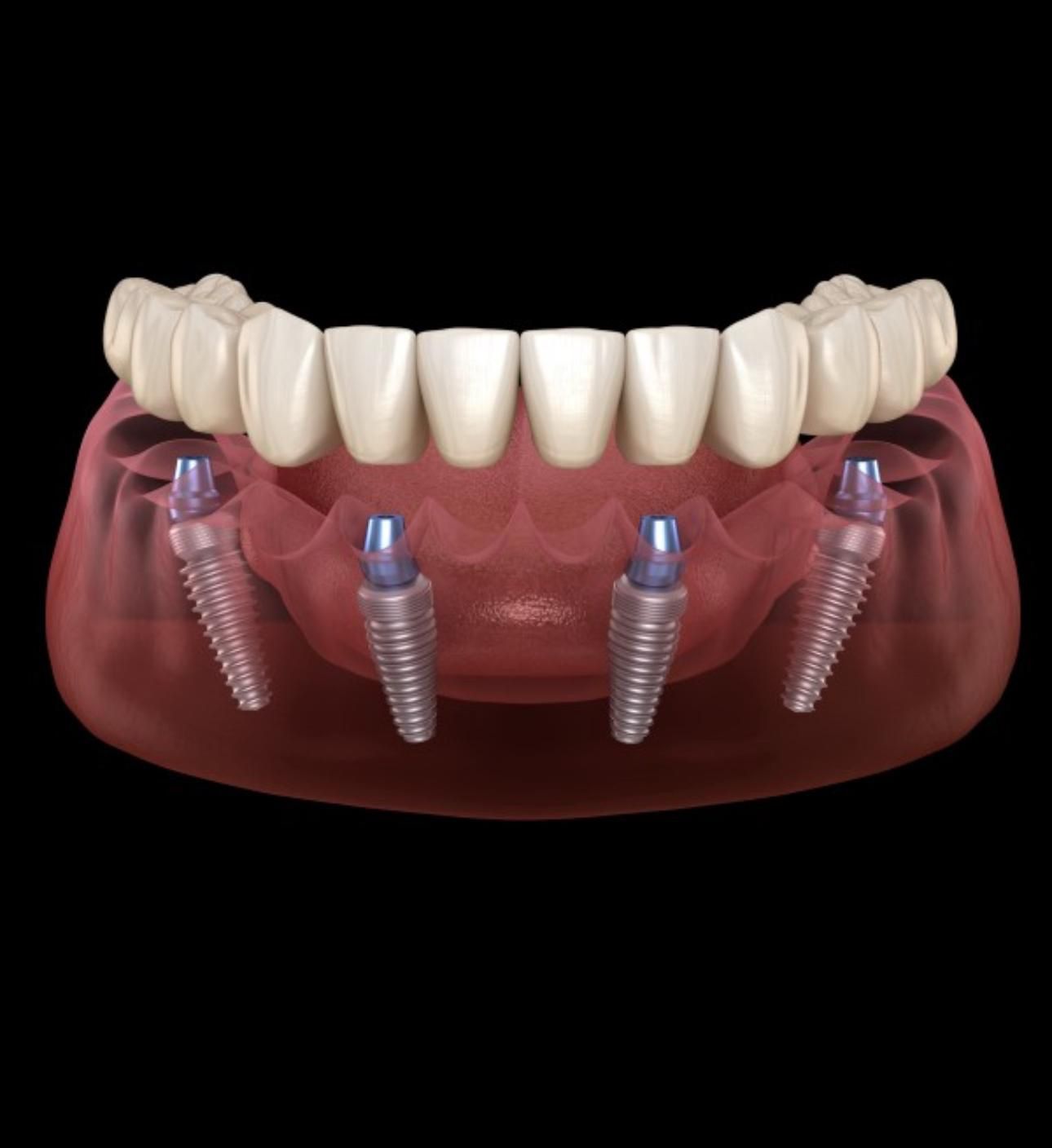
All-on-4 implant treatment is a modern technique that restores a full set of fixed teeth using only four strategically placed implants in a single jaw, offering a fast, stable, and long-lasting solution for patients with complete or advanced tooth loss.
What Is All-on-4 Implant Treatment? Who Is It Suitable For, and How Is It Performed?
All-on-4 implant treatment is a modern approach that allows fixed teeth to be placed using only four implants in a single jaw for patients who are completely edentulous or whose remaining teeth are severely damaged and need to be extracted.
The main goals of this system are to provide patients with fixed teeth comfort in a short time and to restore function and aesthetics even in cases with bone loss, without the need for advanced surgical procedures.
However, All-on-4 is not a method that is automatically suitable for everyone. Its success depends on proper patient selection, accurate surgical planning, and correct prosthetic design.
Why Was All-on-4 Treatment Developed?
In cases of complete tooth loss, the traditional approach usually required:
A high number of implants
Long healing periods
Additional surgeries such as bone grafting and sinus lifting
The All-on-4 concept was developed to meet the following needs:
Achieving fixed teeth with fewer implants
Providing an alternative solution for patients with insufficient bone
Shortening the overall treatment time
Offering a permanent alternative to removable dentures
In properly selected cases, All-on-4 can deliver highly successful results both biologically and functionally.
What Does All-on-4 Provide?
All-on-4 implant treatment offers patients:
Fixed teeth comfort
Strong chewing function
A younger and better-supported facial appearance
Freedom from removable dentures
A shorter treatment timeline
For these advantages to be long-lasting, the system must be planned and executed correctly.
All-on-4 is not just about the number of implants; it is a balance system.
Who Is All-on-4 Suitable For?
All-on-4 treatment is generally suitable for:
Patients who have lost all their teeth
Patients whose teeth are severely mobile and require extraction
Those who do not want removable dentures
Patients who are not suitable for conventional implant planning due to limited bone volume
Patients who want fixed teeth in a short time
Who Requires Careful Evaluation?
All-on-4 may not be ideal for every patient. Detailed analysis is especially necessary in cases of:
Advanced bone resorption
Uncontrolled systemic diseases
Heavy smoking
Severe teeth grinding (bruxism)
Very high chewing forces
In such situations, alternative plans (such as All-on-6) or different implant strategies may be more appropriate.
How Does the All-on-4 System Work?
In the All-on-4 concept:
Two implants are placed vertically in the anterior region
Two implants are placed at an angle in the posterior region
This angled placement allows:
Maximum use of available bone
Avoidance of sinus cavities and nerve structures
Use of longer implants
Wider prosthetic support
Angled implants require high surgical expertise.
Incorrect angulation means long-term problems.
How Is All-on-4 Treatment Planned?
A successful All-on-4 treatment is achieved during the planning phase, not on the day of surgery.
1) Clinical examination
Intraoral evaluation
Analysis of gums and soft tissues
2) Radiological evaluation
Panoramic X-ray
Mandatory 3D tomography (CBCT)
With CBCT imaging, the following are assessed in advance:
Bone thickness and density
Location of sinuses and nerves
Implant angulations
Ideal support points for the prosthesis
3) Functional planning
In All-on-4, placing implants alone is not sufficient. The following must be carefully planned:
Chewing forces
Prosthesis length
Posterior support distance
Bite balance
Stages of All-on-4 Treatment
1) Extraction of necessary teeth (if present)
Infected and non-restorable teeth are removed.
2) Implant placement
Four implants are placed into the bone at the planned angles.
3) Temporary fixed teeth (in suitable cases)
If adequate primary stability is achieved, temporary fixed teeth can be placed on the same day or shortly after.
This stage is psychologically very valuable for patients.
However, same-day teeth are not mandatory in every case.
4) Healing and adaptation period
Bone–implant integration takes place.
5) Fabrication of permanent teeth
The final prosthesis is designed by optimizing function, aesthetics, and durability together.
Is Same-Day Teeth Possible for Everyone with All-on-4?
No.
This is a very important point.
“Same-day teeth” should only be performed when:
Adequate bone stability is present
Implant positions are correct
Chewing forces are controlled
Otherwise, the following risks may occur:
Implant failure
Long-term bone problems
Prosthetic fractures
The correct approach is to do what is safest for the patient, not what is fastest.
All-on-4 or All-on-6?
This is a very common question, and the answer depends on the patient.
All-on-4:
Fewer implants
Shorter surgical procedure
Successful in properly selected cases
All-on-6:
More support
Advantageous in patients with high chewing forces
May be safer in the long term
More implants are not always better, and fewer implants are not always sufficient.
The correct number is determined for the right patient.
Is All-on-4 Permanent? How Long Does It Last?
With proper planning and maintenance, All-on-4 can be used successfully for many years.
Factors affecting longevity include:
Surgical accuracy
Implant–prosthesis compatibility
Bite balance
Oral hygiene
Regular follow-ups
Teeth grinding habits
All-on-4 is not a “place it and forget it” solution; it is a system that requires follow-up.
What Should Be Considered After All-on-4 Treatment?
Soft foods during the initial period
Extra attention to oral hygiene
Regular professional cleanings
Avoid breaking hard objects with teeth
Use of a night guard if necessary
Patients who follow these guidelines have a very high success rate.
What Determines the Cost of All-on-4 Treatment?
The cost of All-on-4 treatment depends on:
The implant brand used
The prosthetic material
The structure of temporary and permanent teeth
Additional surgical requirements
Case complexity
Planning and follow-up process
An exact price can only be determined after clinical examination and tomography.
This is the healthiest approach for both patient and clinician.
Frequently Asked Questions
Is All-on-4 suitable for everyone?
No. Suitability must always be evaluated.
What is the difference from removable dentures?
All-on-4 is fixed, does not move, and provides stronger function.
Is same-day teeth mandatory?
No. The safest option should always be chosen.
Conclusion: All-on-4 Is Not a “Quick Fix,” but a Powerful System in the Right Hands
All-on-4 implant treatment can significantly improve quality of life when the right patient is selected, proper planning is done, and correct execution is achieved.
The success of All-on-4 lies not in the number of implants, but in the quality of the planning.