




All-on-6 Implant
Enhanced Stability for Full Arch Restoration
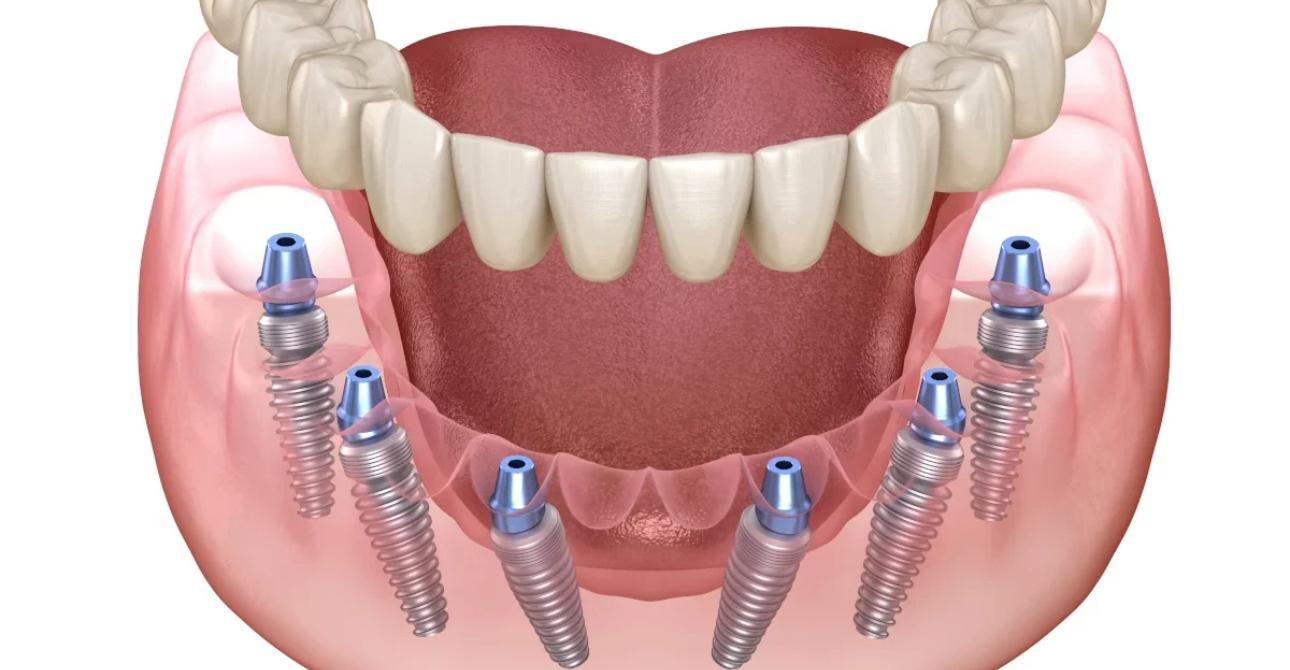
All-on-6 implant treatment is an advanced full-arch solution that restores fixed teeth using six strategically placed implants in one jaw, providing greater support, balanced load distribution, and long-term stability for patients with complete or advanced tooth loss.
What Is All-on-6 Implant Treatment? Who Is It Suitable For, and How Is It Performed?
All-on-6 implant treatment is an advanced full-arch implant rehabilitation method that allows fixed teeth to be placed using six implants in a single jaw for patients who are completely edentulous or whose existing teeth are severely damaged and require extraction.
The main goal of this treatment is to provide more support, more balanced load distribution, and higher long-term stability compared to All-on-4.
All-on-6 is especially preferred for patients with high chewing forces who want a more durable, stable, and secure long-term solution.
Why Is All-on-6 Treatment Preferred?
The main challenge in full-arch implant treatments is this:
How and where are chewing forces distributed?
All-on-6 is preferred due to the following advantages:
Increased implant support
More balanced distribution of chewing forces
Reduced stress on the prosthesis
Better control of bone and implant loading in the long term
A safer structure for patients with teeth grinding (bruxism)
For this reason, All-on-6 is often considered a “more secure and long-term” solution.
What Does All-on-6 Provide?
A properly planned All-on-6 treatment provides the patient with:
Fixed and strong teeth
High chewing comfort
A more stable prosthetic structure
Lower risk of long-term complications
Preservation of facial support
Higher quality of life compared to removable dentures
The critical point is this:
All-on-6 is not simply “two more implants.”
It is a load-distribution and balance system.
Who Is All-on-6 Suitable For?
All-on-6 treatment is generally suitable for:
Fully edentulous patients
Advanced periodontal cases where all teeth must be extracted
Patients with high chewing forces
Individuals with a history of teeth grinding (bruxism)
Those seeking a longer-lasting and safer solution
Patients with sufficient bone volume for All-on-6
Who Benefits the Most?
All-on-6 may be particularly advantageous for:
Male patients
Individuals with strong jaw structures
Patients who frequently consume hard foods
Those who say, “I want to do it once and use it trouble-free for many years”
In this patient group, All-on-6 may be a more balanced option compared to All-on-4.
Is All-on-6 Suitable for Everyone?
No.
As with any implant treatment, All-on-6 requires a thorough suitability assessment. The following factors must be carefully analyzed:
Bone height and thickness
Bone density
Location of sinus cavities and nerve structures
Jaw relationships
General health status
Smoking habits
In some cases with insufficient bone volume, All-on-6 may not be feasible. In such situations, All-on-4 or alternative surgical plans may be more appropriate.
How Does the All-on-6 System Work?
In the All-on-6 concept:
Two implants are placed in the anterior region
Four implants are placed in the middle and posterior regions
This distribution allows:
Wider prosthetic support
Reduced load on posterior areas
Lower stress on each individual implant
Minimization of long bridge spans
As a result, the system becomes mechanically more balanced.
How Is All-on-6 Treatment Planned?
A successful All-on-6 treatment is achieved not in the operating room, but during the planning phase.
1) Clinical evaluation
Intraoral examination
Gum and soft tissue analysis
2) Radiological evaluation
Panoramic X-ray
Mandatory 3D tomography (CBCT)
With CBCT imaging, the following are calculated with millimetric precision:
Implant positions
Implant angulations
Bone quality
Location of critical anatomical structures
3) Prosthetic (teeth) planning
In All-on-6, planning is not limited to implants alone. The following are designed together:
Tooth alignment
Bite relationship
Prosthesis length
Aesthetic smile line
Stages of All-on-6 Treatment
1) Extraction of necessary teeth
Unhealthy and infected teeth are removed.
2) Implant placement
Six implants are placed into the bone at the predetermined positions and angles.
3) Temporary fixed teeth (in suitable cases)
If sufficient primary stability is achieved, temporary fixed teeth can be placed:
On the same day, or
Within a short period of time
Here, safety is more important than speed.
4) Healing phase
Osseointegration between the implants and the bone is completed.
5) Fabrication of permanent teeth
The final prosthesis is created by optimizing function, aesthetics, and durability together.
Is “Same-Day Teeth” Always Possible with All-on-6?
No.
Same-day teeth:
Can be an advantage
But are not a requirement
If sufficient stability is not present, same-day teeth may increase risk.
The correct clinical approach is:
“To offer the safest solution, not the fastest one.”
All-on-6 or All-on-4?
There is no single answer to this question.
All-on-4:
Fewer implants
Shorter surgical procedure
Successful in well-selected cases
All-on-6:
More support
More balanced load distribution
Greater long-term stability
The right choice depends on the patient’s bone structure, chewing forces, and expectations.
Is All-on-6 Permanent? How Long Does It Last?
With proper planning and maintenance, All-on-6 can be used successfully for many years.
Factors affecting longevity include:
Surgical precision
Implant–prosthesis compatibility
Bite balance
Oral hygiene
Regular follow-ups
Teeth grinding habits
All-on-6 is a strong system, but it requires ongoing care.
What Should Be Considered After All-on-6 Treatment?
Soft diet during the initial period
Careful attention to oral hygiene
Regular professional maintenance
Avoid breaking hard objects with teeth
Use of a night guard when necessary
Patients who follow these guidelines have a very high success rate.
What Determines the Cost of All-on-6 Treatment?
The cost of All-on-6 treatment is not determined solely by the number of implants.
Factors affecting the price include:
The implant brand used
Prosthetic material
Structure of temporary and permanent teeth
Additional surgical procedures
Case complexity
Planning and follow-up process
Therefore, clinical examination and tomography are required to determine an exact cost.
Frequently Asked Questions
Is All-on-6 suitable for everyone?
No. Suitability must be evaluated individually.
What is the difference compared to removable dentures?
All-on-6 is fixed, stronger, and significantly more comfortable.
Is All-on-6 more long-lasting?
In suitable cases, yes—because load distribution is more balanced.
Conclusion: All-on-6 Is a Powerful System—In the Right Hands
All-on-6 implant treatment provides high comfort, strong stability, and long-term success when the right patient is selected and proper planning is performed.
It should always be remembered:
The success of All-on-6 does not come from the number of implants, but from the quality of planning and the accuracy of execution.