
E-max Crown
The Gold Standard of Natural Aesthetics
E-max crowns are advanced lithium disilicate restorations designed to mimic natural tooth enamel with exceptional translucency and realism, making them the ideal choice for patients seeking the most natural and aesthetic results—especially in the front teeth.
What Is an E-max Crown (Lithium Disilicate)? Who Is It Suitable For, and What Are Its Advantages?
An E-max crown is one of the most natural-looking restoration systems in aesthetic dentistry, made from lithium disilicate ceramic. Thanks to its high light translucency and glass-ceramic structure, it delivers results that are closest to natural tooth enamel—especially in the front teeth.
E-max crowns are designed for patients who say:
“I don’t want it to look like a crown,”
“I want it to transmit light like a natural tooth,”
“I want my smile to look extremely natural.”
Why Are E-max Crowns Preferred?
The strongest advantage of E-max crowns is aesthetics. Key benefits include:
Very high light translucency (maximum natural appearance)
Enamel-like look due to glass-ceramic structure
Suitable for very thin and delicate designs
No “crown feeling” in the front teeth
Exceptional color depth and vitality
Long-term aesthetic stability in properly selected cases
For this reason, E-max is preferred by patients with the highest aesthetic expectations.
What Do E-max Crowns Correct?
E-max crowns are particularly ideal for the following situations:
1) Front tooth aesthetic problems
Tooth color disharmony
Mild discoloration
Aesthetic imperfections in front teeth
2) Tooth form and shape issues
Short or small front teeth
Chipped incisal edges
Aesthetically disproportionate tooth shapes
3) Gaps between teeth
Diastema (spaces between front teeth)
Symmetry problems
4) Smile design cases
Hollywood Smile planning
Cases where “natural aesthetics” are the top priority
Who Is Suitable for E-max Crowns?
E-max crowns are generally suitable for:
Patients seeking aesthetic treatment for front teeth
Individuals who want extremely natural-looking teeth
Those requesting highly translucent restorations
Cases planned for laminate veneers or minimal preparation
Patients undergoing smile design treatments
Who Requires Careful Evaluation?
More caution is needed in patients with:
Severe teeth grinding (bruxism)
High chewing forces in the back teeth
Long-span bridge planning
Large implant-supported restorations
In such cases, zirconium crowns may be a safer option than E-max.
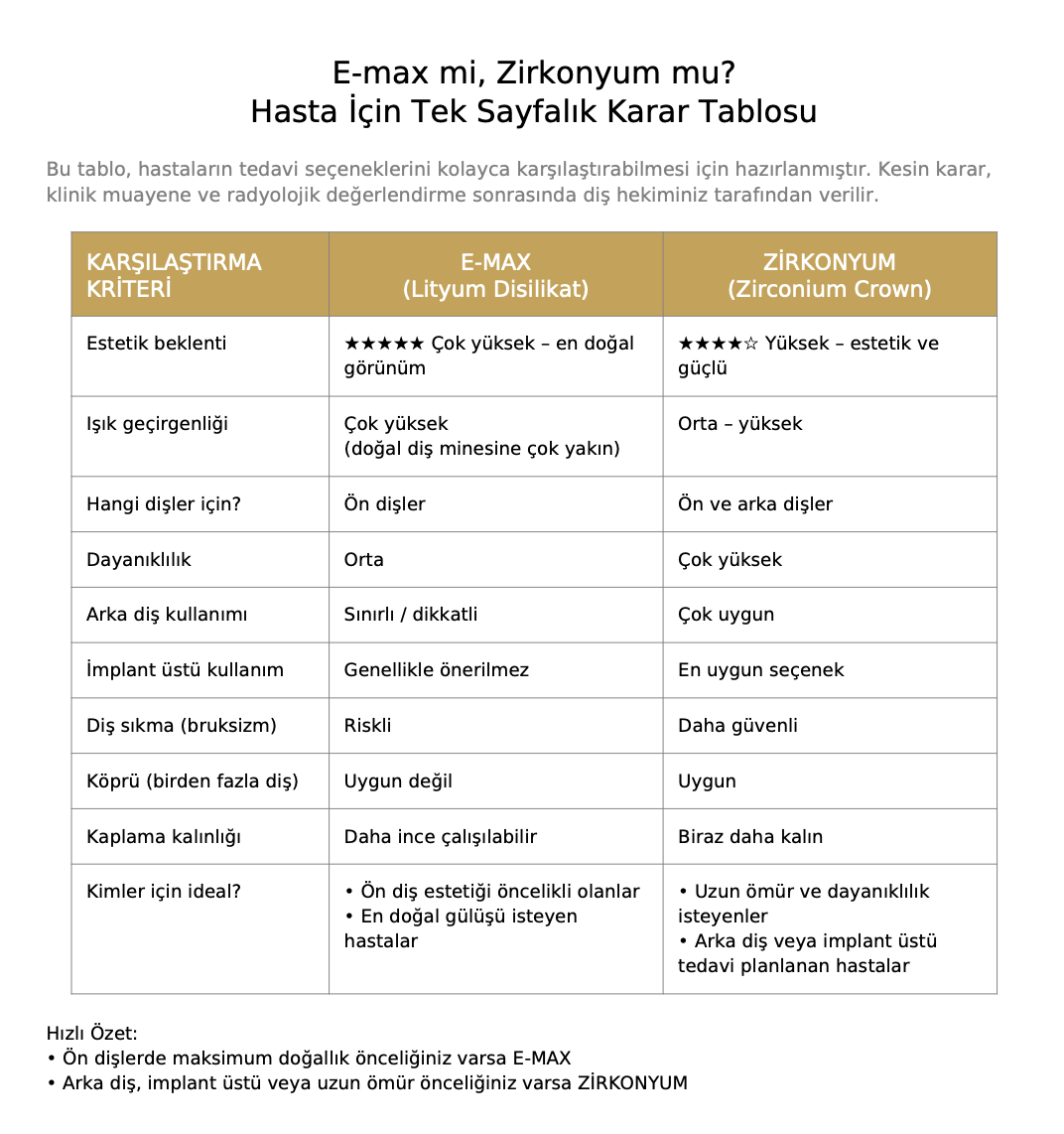
Key Differences Between E-max and Zirconium Crowns
This comparison is critical for many patients.
E-max crowns:
Superior aesthetic performance
Maximum light translucency
Ideal for front teeth
Lower mechanical strength (use in back teeth requires caution)
Zirconium crowns:
Balanced combination of aesthetics and strength
More suitable for back teeth and implant-supported restorations
Preferred for long-span bridges
In short:
E-max is the champion of aesthetics,
while zirconium offers the balance of aesthetics and strength.
How Are E-max Crowns Made?
The success of E-max treatment depends on extremely precise planning and high laboratory quality.
1) Examination and aesthetic analysis
Smile line evaluation
Lip–tooth relationship
Shade analysis
2) Tooth preparation
Usually minimal tooth reduction
The goal is maximum preservation of natural tooth structure
3) Impression taking
Digital impressions are preferred
Precision is critical
4) Temporary restorations
Provide an aesthetic preview
Protect the prepared teeth
5) Laboratory stage
Production from E-max blocks using CAD-CAM or press techniques
Hand-layered characterization for natural details
6) Try-in and bonding
Detailed evaluation of shade, translucency, and form
Use of special adhesive bonding systems
Do E-max Crowns Look Natural?
Yes—when done correctly, E-max crowns are the most natural-looking restorations available.
Key factors that determine natural appearance:
Color depth
Translucency
Surface texture
Gum harmony
Tooth form
A well-made E-max crown does not make people ask:
“Is that a crown?”
Are E-max Crowns Durable? How Long Do They Last?
E-max excels in aesthetics, but its mechanical strength is lower than zirconium.
Factors affecting longevity include:
Area of use (front vs. back teeth)
Teeth grinding habits
Bite adjustments
Oral hygiene
Regular dental check-ups
When used in the correct indication and region, E-max crowns can function successfully for many years.
Do E-max Crowns Hurt?
No.
Local anesthesia is used during the procedure.
Mild sensitivity may occur afterward, but it is usually short-lived.
What Should Be Considered After E-max Crown Treatment?
Avoid very hard foods
Do not crack shells or hard objects with teeth
Maintain good brushing and flossing habits
Use a night guard if bruxism is present
Attend regular dental check-ups
E-max crowns are highly aesthetic but delicate restorations—they require proper care.
What Determines the Cost of E-max Crowns?
E-max crown pricing depends on:
Number of teeth treated
Quality of the E-max material used
Laboratory craftsmanship
Level of aesthetic expectations
Case complexity
For accurate pricing, a clinical examination and aesthetic evaluation are essential.
Frequently Asked Questions
Is E-max or zirconium better?
It depends on the purpose. E-max is preferred for front teeth, while zirconium is better for back teeth.
Do E-max crowns discolor over time?
No. However, poor oral hygiene may cause plaque buildup that affects surface appearance.
Can E-max be used on implants?
It is generally not preferred. Zirconium is a safer option for implant-supported restorations.
Conclusion: E-max Crowns Are the Peak of Aesthetics—When Used in the Right Case
E-max crowns deliver the most natural results in front tooth aesthetics, but they require correct patient selection and precise indication.
It should be remembered:
The success of E-max depends not only on the material itself, but on proper case selection, meticulous planning, and high-quality laboratory work.